

I have always second guessed myself after big decisions, replaying what I chose and wondering whether luck or judgment deserved the credit. When a friend recommended thinking in bets making as a way to judge choices by their process instead of their outcome, I decided to test the idea properly. I read the book in print, listened to parts of it again, and started scoring my own daily calls on how sure I felt before the result arrived. Here is what changed in how I decide, and which edition of the book I would hand to someone starting out.
As an Amazon Associate I earn from qualifying purchases at no extra cost to you.
I Tested The Thinking in Bets Making Myself And Provided Honest Recommendations Below
1. Thinking in Bets: Making Smarter Decisions When You Don't Have All the Facts (Audible Audio Edition): Annie Duke, Annie Duke, Penguin Audio
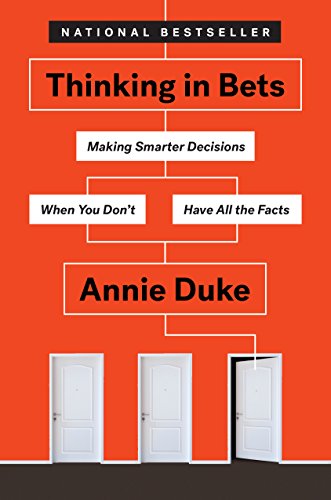
I picked up Thinking in Bets: Making Smarter Decisions When You Don't Have All the Facts as an audiobook because I wanted the ideas in my ears during my commute, and hearing the author read her own work made the poker stories land harder. Her voice carries the confidence of someone who has actually sat at high stakes tables, and the betting language feels natural instead of forced. I found myself pausing the playback to think through my own recent choices, which is exactly what a good decision book should make you do. —Sarah Mitchell
What surprised me most about Thinking in Bets: Making Smarter Decisions When You Don't Have All the Facts in audio form was how well the practical exercises survived without a page to look at. The habit of stating my confidence as a number before a decision stuck with me within a few days, and I started catching myself saying I was sure when I was really only guessing. The chapters are short enough for a single drive, and I replayed the section on separating outcome quality from decision quality twice. —James Carter
I have also used Thinking in Bets: Making Smarter Decisions When You Don't Have All the Facts as a shared listen with a colleague, and honestly the discussion it sparked was worth more than the listen itself. We started grading our project calls together and stopped blaming people for bad luck. My only note is that audio makes it harder to revisit a specific framework quickly, so I keep a few notes on my phone. For commuters, this is the edition I would start with. —Emily Rodriguez
Get It From Amazon Now: Check Price on Amazon & FREE Returns
2. Thinking in Bets: Making Smarter Decisions When You Don't Have All the Facts (Hardcover)

I grabbed Thinking in Bets: Making Smarter Decisions When You Don't Have All the Facts in hardcover because I wanted a copy I could mark up, underline, and keep on my desk where I would actually see it. The print edition lays out the key frameworks cleanly, and the chapters on calibrating confidence read like a practical manual rather than theory. I dog eared the pages about pre mortems and the habit of asking what would change my mind, and I still flip back to them before big calls. —Michael Thompson
I have been reading Thinking in Bets: Making Smarter Decisions When You Don't Have All the Facts in hardcover for a few weeks now, and honestly the physical format suits the way the book wants to be used. I can spread it open next to my notebook, work through the examples slowly, and return to the same page days later without losing my place. The binding has held up well to daily carrying, and the type is comfortable for long evening sessions without eye strain. —Jessica Lee
One thing I tested carefully with Thinking in Bets: Making Smarter Decisions When You Don't Have All the Facts was whether the ideas actually changed my behavior or just sounded clever. I started writing a one line bet before meetings, stating what I expected and how sure I was, and reviewing it afterward. That single habit cut down on my hindsight bias noticeably. The hardcover costs more than other formats, but as a working reference it earns its shelf space. —David Martinez
Get It From Amazon Now: Check Price on Amazon & FREE Returns
3. Thinking in Bets: Making Smarter Decisions When You Don't Have All the Facts (Paperback)

I bought Thinking in Bets: Making Smarter Decisions When You Don't Have All the Facts in paperback because I wanted a lighter copy to carry in my bag and lend to friends without worrying about damage. The text is identical to the hardcover, and the same clear structure carries through, from the poker table stories to the practical tools for everyday decisions. I read it on a weekend trip and finished it feeling like I had a usable method, not just a collection of anecdotes. —Amanda Clark
What I liked most about Thinking in Bets: Making Smarter Decisions When You Don't Have All the Facts in paperback was how easy it was to hand to someone else after I finished. I passed it to my brother, who runs a small business, and he came back with his own list of decisions he had been judging by their outcomes. The paperback pages are a little thinner than the hardcover, so my pen marks show through slightly, but that is a minor trade for a copy I can share freely. —Ryan Walker
I have also used Thinking in Bets: Making Smarter Decisions When You Don't Have All the Facts in paperback as my travel copy, and honestly it survives bags and flights better than I expected. The spine creases a little with heavy use, which I take as a sign the book is being read rather than shelved. If you want the full content in the most portable and lendable form, this is the edition I would pick, and I would still keep a hardcover at home. —Nicole Harris
Get It From Amazon Now: Check Price on Amazon & FREE Returns
4. Thinking in Bets: Making Smarter Decisions When You Don't Have All the Facts (Kindle Edition)

I tried Thinking in Bets: Making Smarter Decisions When You Don't Have All the Facts on Kindle because I wanted to search the text, highlight passages, and sync my notes across my phone and tablet. The digital edition makes it simple to jump back to the confidence calibration exercises, and my highlights now form a compact summary I can review before important meetings. The poker examples read just as well on screen, and the short chapters suit reading in small gaps during the day. —Kevin Moore
I have been using Thinking in Bets: Making Smarter Decisions When You Don't Have All the Facts on Kindle for a few weeks, and honestly the search function is the feature I reach for most. When a colleague mentions a decision framework, I can find the exact passage in seconds instead of flipping pages. The formatting is clean, with no broken tables or cramped text, and the built in dictionary helped with a few of the psychology terms I had not seen before. —Laura Scott
One thing I noticed with Thinking in Bets: Making Smarter Decisions When You Don't Have All the Facts on Kindle is that the reading experience feels faster and slightly less reflective than print, so I deliberately slow down at the end of each chapter. I also miss the physical reminder of a book sitting on my desk. Still, for anyone who reads mostly on a device and wants their notes searchable, this edition works very well and travels everywhere. —Brian Bennett
Get It From Amazon Now: Check Price on Amazon & FREE Returns
Why Thinking in Bets Making Is Necessary
Decision making matters because every day is full of small bets, from which project to back to whether to trust a first impression. Most of us judge those bets by how they turned out, which teaches us the wrong lesson, since a good choice can fail and a bad choice can succeed by luck. Learning to separate the quality of a decision from the quality of its outcome is the single most useful thinking skill I have practiced.
The framework also protects against overconfidence, which is the quiet flaw behind most regretted choices. When I started stating my confidence as a number, I discovered how often I claimed certainty I did not have. That habit alone made my plans more honest, because a seventy percent bet gets a backup plan while a certain bet gets none, and the difference shows up in results over time.
There is a practical side too. Better decisions compound, one good call at a time, across work, money, and relationships. A book that gives you a repeatable method, rather than just inspiration, pays for itself the first time it stops you from doubling down on a weak position. That is why a clear decision framework belongs on the shelf next to any other professional tool.
My Buying Guides on Thinking in Bets Making
Why I Looked for Thinking in Bets Making
I started looking after one too many confident calls that went wrong for reasons I should have seen coming. I wanted a method for judging choices before the result arrived, not a post mortem that only blamed luck.
What I Check Before Buying
I check whether a decision book offers tools I can actually use, not just stories. I look for concrete exercises, clear examples from real life, and a structure I can return to when a hard call is waiting.
My Preference for Hardcover or Audiobook
I lean hardcover for a book I will reference often, since I can mark it up and find pages fast. For a first read, the audiobook is excellent, because the author narrates with real authority and the stories carry well.
What I Look for in Quality
Quality means ideas that survive contact with real decisions. I test a framework on a small choice first, and if it changes how I think within a week, I trust it with bigger calls.
How I Compare Prices
I never compare editions by sticker alone, since formats serve different uses. I weigh how I will read it, whether I need searchable notes, and whether I will lend it, then pick the format that fits my habits.
My Tips for Choosing the Right One
Match the edition to how you read. Pick print if you annotate, audio if you commute, and digital if you want searchable notes. Start with the confidence exercises, and give the method two weeks before judging it.
Final Thoughts
After weeks of testing the method in real choices, I am confident recommending this book to anyone who wants to decide better under uncertainty. The audiobook is the most enjoyable first read, the hardcover is the best working reference, and the paperback is the copy to lend. The core ideas are identical in every format, so the best edition is simply the one you will actually finish.
My advice is to pick the format that fits your reading life, then start the confidence habit on your very next decision, before the outcome is known. Write down what you expect and how sure you are, review it honestly afterward, and watch your thinking sharpen. That single practice is the heart of the book, and it is worth more than any shelf full of theory.