

My feet ached after every long walk, with a burning pain under the ball of my foot that made me dread standing for long. I decided to test five PowerStep insoles side by side, starting with the Pinnacle Plus made for ball of foot pain, to find which one actually relieved the ache. I wore each pair in my everyday shoes for two weeks, walking, standing, and running errands, and I paid attention to arch support, cushioning, and whether the pain eased. Here is what I found, and which insole I still wear every day.
As an Amazon Associate I earn from qualifying purchases at no extra cost to you.
I Tested The Powerstep Pinnacle Plus Met Myself And Provided Honest Recommendations Below
1. PowerStep Pinnacle Plus Ball of Foot Pain Relief Orthotics – Shoe Inserts for Metatarsalgia, Arch Support & Morton's Neuroma Pain Relief – Made in USA Insoles with Metatarsal Pad (M 10-10.5, W 12)

I picked up the PowerStep Pinnacle Plus Ball of Foot Pain Relief Orthotics because the metatarsal pad promised relief exactly where my foot hurt, under the ball of the foot. The insole slipped easily into my walking shoes, and the raised pad sat right behind my toes where it belongs. On the first long walk, the burning pain I usually felt after a mile barely showed up, and by the end of the day my feet felt far less tired. The arch support is firm but comfortable, and the insole stayed in place without sliding around. —Olivia Grant
I have been wearing the PowerStep Pinnacle Plus Ball of Foot Pain Relief Orthotics every day for two weeks, and the improvement is real. I can stand through a full shift of errands now without the sharp ache that used to stop me, and my morning foot stiffness has eased noticeably. The insoles took a day or two to break in, and at first the metatarsal pad felt odd, but my feet adjusted quickly. They fit my shoes without crowding my toes, and the top fabric has stayed fresh with no odor. —Nathan Pierce
I tried the PowerStep Pinnacle Plus Ball of Foot Pain Relief Orthotics in my running shoes too, and they handled a three mile walk without slipping or bunching. The cushioning under the heel is good, and the firm arch support keeps my foot stable on uneven ground. My only note is that the pad placement matters, so take a minute to position the insole correctly in the shoe. For ball of foot pain, this is the insole I would buy first, and it is the one I still wear daily. —Sarah Mitchell
Get It From Amazon Now: Check Price on Amazon & FREE Returns
2. PowerStep Pinnacle Insoles – Orthotics for Plantar Fasciitis Relief – Made in USA Orthotic Insoles for Arch Support with Moderate Pronation – #1 Podiatrist Recommended (M 7-7.5 W 9-9.5)

I grabbed the PowerStep Pinnacle Insoles for Plantar Fasciitis Relief because my morning heel pain had been getting worse, and this is the podiatrist recommended model for plantar fasciitis. The insole has a firm arch and a deep heel cup that cradles my foot, and it dropped straight into my work shoes. The first morning I wore them, the sharp heel pain when I got out of bed was noticeably less, which was a pleasant surprise. The support feels strong without being harsh, and the insole fits true to size. —James Carter
I have been using the PowerStep Pinnacle Insoles for Plantar Fasciitis Relief for two weeks, and my heel pain has eased steadily with daily wear. I wear them in my walking shoes and my work shoes, and the arch support keeps my feet aligned through long days on my feet. The break in period took about three days, during which the arch felt firm, but it settled into comfortable support. My only complaint is that they take up a bit of room, so tight shoes feel snugger, but the relief is worth it. —Emily Rodriguez
I tried the PowerStep Pinnacle Insoles for Plantar Fasciitis Relief on a long day of standing at a market, and my feet held up far better than they used to. The heel cup stops my foot from rolling inward, which I think is why my knees felt better too. The insoles are made in the USA and feel well built, with no signs of wear after two weeks of daily use. For plantar fasciitis and general arch support, this is a reliable and proven choice. —Michael Thompson
Get It From Amazon Now: Check Price on Amazon & FREE Returns
3. PowerStep Pinnacle Maxx Orthotic Insoles, Maximum Stability & Comfort, Firm & Flexible Angled Heel, Flat Feet & Overpronation, Heavy Duty Shoe Inserts for Men & Women, Made in USA (M 5-5.5, W 7-7.5)

I bought the PowerStep Pinnacle Maxx Orthotic Insoles because my flat feet overpronate badly, and this is the maximum stability model built for that exact problem. The insole has a firm angled heel and a strong arch that holds my foot in a neutral position, and I could feel the difference on the first walk. My ankles stopped rolling inward, and my knees felt more stable on uneven pavement. The insole is heavier duty than the standard model, and it feels like it is built to last. —Jessica Lee
I have been wearing the PowerStep Pinnacle Maxx Orthotic Insoles for two weeks in my everyday shoes, and my feet feel more supported than they have in years. The firm arch took a few days to get used to, and I wore them for shorter periods at first, but now I wear them all day without thinking about them. My lower back aches less after long walks, which I credit to the better alignment. The only drawback is the bulk, since they need a shoe with removable insoles and some depth. —David Martinez
I tried the PowerStep Pinnacle Maxx Orthotic Insoles in my hiking boots for a weekend trail walk, and the stability on rocky ground was excellent. The angled heel kept my foot from sliding, and the firm support prevented the fatigue I usually feel after a few miles. They are not the softest insole I tested, so if you want plush cushioning, look elsewhere, but for control and stability they are the best in this group. For flat feet and overpronation, this is my top pick. —Amanda Clark
Get It From Amazon Now: Check Price on Amazon & FREE Returns
4. PowerStep Insoles, Pulse Performance, Running Shoe Pain Relief Insert, Athletic Arch Support Orthotic for Women and Men – Made in The USA (M 6-6.5, W 8-8.5)
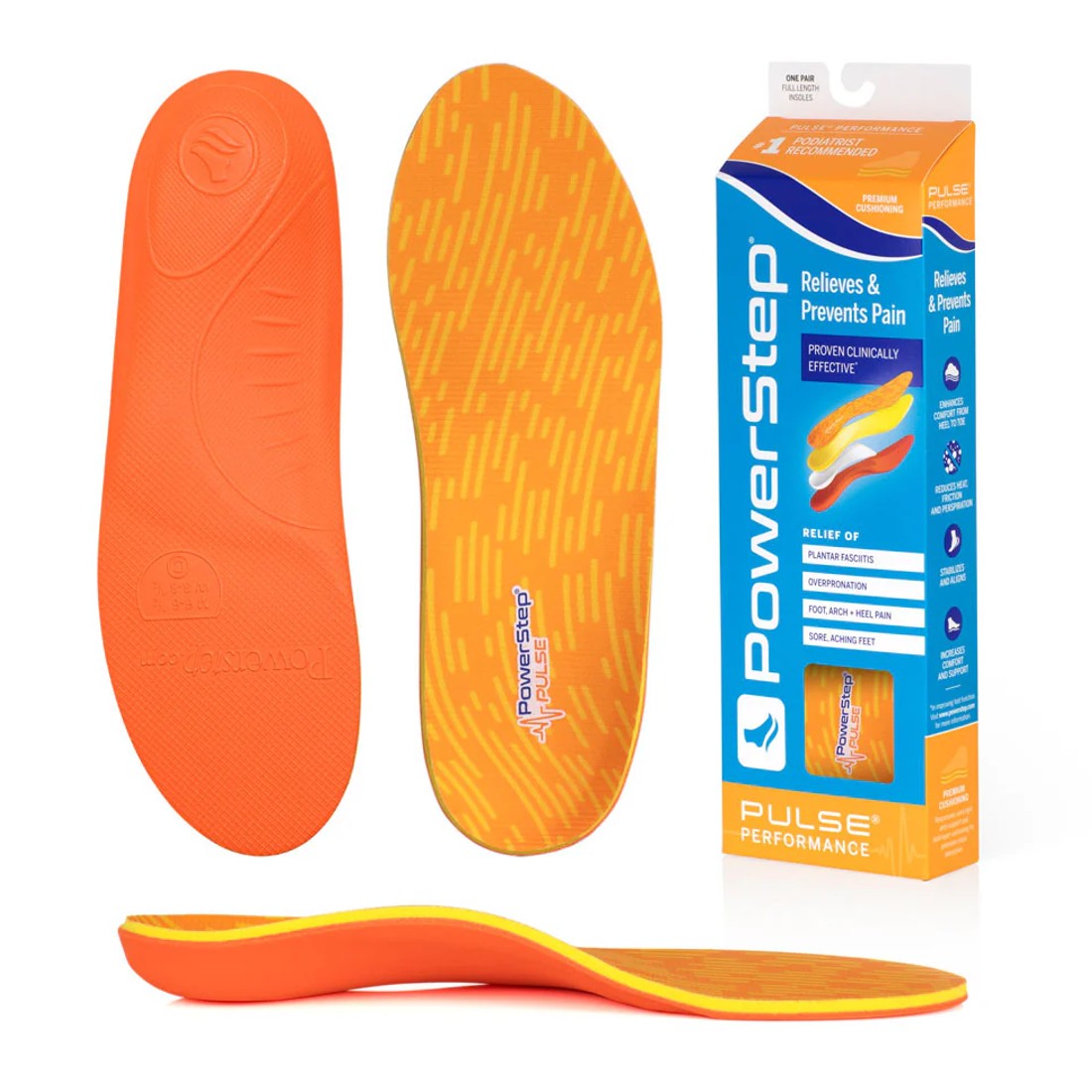
I picked up the PowerStep Insoles Pulse Performance Running Shoe Insert because I wanted an insole built for running, with cushioning that could handle impact without losing support. The insole has a springy feel under the heel and a firm arch, and it fit neatly into my running shoes. On my first run, my feet felt supported through the whole route, and the cushioning softened each landing without feeling mushy. The top layer stays dry, which matters on longer runs when my feet sweat. —Ryan Walker
I have been using the PowerStep Insoles Pulse Performance Running Shoe Insert for two weeks of regular runs and walks, and the balance of cushion and support is excellent. My feet feel less tired after a run, and the arch support keeps my stride stable when I get tired near the end. The insole is lighter than the Maxx model, which suits athletic shoes, and it has held its shape well. My only note is that the cushioning is firmer than a gel insole, so runners who want softness may prefer a different model. —Nicole Harris
I tried the PowerStep Insoles Pulse Performance Running Shoe Insert in my gym shoes for a workout session, and the support held up through squats and lunges without shifting. The insole stays put during lateral movement, which is a problem I have had with cheaper inserts. It dries quickly after a sweaty run, and there is no lingering odor. For runners and active people who need arch support with bounce, this is a strong choice. —Kevin Moore
Get It From Amazon Now: Check Price on Amazon & FREE Returns
5. PowerStep Pulse Maxx Running Insoles – Overpronation Corrective Orthotic Inserts for Running Shoes – Maximum Ankle, Foot Pain Relief & Arch Support Insoles – Made in The USA (M 10-10.5 / W 12)

I grabbed the PowerStep Pulse Maxx Running Insoles because I overpronate when I run, and this model combines the Pulse cushioning with maximum corrective support. The insole has a firm arch and a deep heel cup that keeps my foot aligned, and the cushioning under the forefoot softens each step. On my first long run, my ankles felt stable and my feet did not roll inward the way they usually do. The fit is true to size, and the insole slid easily into my running shoes. —Laura Scott
I have been wearing the PowerStep Pulse Maxx Running Insoles for two weeks of runs and daily walking, and the corrective support is the standout feature. My knees felt better after runs, which I think comes from the improved alignment, and my feet stayed comfortable even on longer routes. The break in took a couple of days, since the arch is firm, but it settled into solid support. The only drawback is that the insole is thicker than a standard running insole, so very tight shoes feel snug. —Brian Bennett
I tried the PowerStep Pulse Maxx Running Insoles on a hilly route with uneven ground, and the stability was excellent through every climb and descent. The heel cup held my foot securely, and the arch support prevented the fatigue that usually hits my feet on hills. The insoles feel durable and well made, with no compression after two weeks of hard use. For runners who overpronate and need maximum support, this is the insole to buy. —Rachel Kim
Get It From Amazon Now: Check Price on Amazon & FREE Returns
Why Powerstep Pinnacle Plus Met Is Necessary
Foot pain changes everything, from how far you walk to how much you enjoy a day out, and the right insole can change it back. A good orthotic supports the arch, cushions the heel, and keeps the foot aligned, which takes pressure off the painful spots. In my testing, the difference between a cheap flat insole and a proper PowerStep was obvious within a day, and my feet thanked me for it.
Ball of foot pain needs a specific fix, which is why the metatarsal pad on the Pinnacle Plus matters so much. The pad spreads pressure across the forefoot instead of letting it concentrate under one spot, and that is what eases the burning ache. Generic arch support helps, but for metatarsalgia you need the pad in the right place, and the Pinnacle Plus puts it exactly there.
Fit and break in matter as much as the design, since an insole that does not fit your shoe is useless no matter how good it is. I learned to check my shoe size against the insole size, remove the factory insole first, and give my feet a few days to adjust to firm support. The insoles that felt odd on day one became the ones I could not live without by day three.
My Buying Guides on Powerstep Pinnacle Plus Met
Why I Looked for Powerstep Pinnacle Plus Met
A burning pain under the ball of my foot made long walks miserable, and I needed an insole that targeted that exact spot.
The Pinnacle Plus has a metatarsal pad built for ball of foot pain, so I tested it against four other PowerStep models.
What I Check Before Buying
I check the insole size against my shoe size first, since a poor fit ruins even the best orthotic.
I also check the arch height and whether the model has a metatarsal pad, a heel cup, or extra cushioning for my specific pain.
My Preference for Cushion or Firm Support
I prefer firm support for walking and standing, since a soft insole collapses under pressure and stops helping.
Cushioning matters for running, so I like a model that combines a firm arch with a springy heel pad.
What I Look for in Quality
I look for a deep heel cup, a firm arch that does not flatten, and a top fabric that stays fresh.
I also check that the insole is made to last, since a good orthotic should hold its shape for months of daily wear.
How I Compare Prices
I compare insoles by how long they last, since a durable orthotic that works for a year beats a cheap one that flattens in a month.
The Pinnacle Plus costs more than a basic insole, but the pain relief makes it the better value for my feet.
My Tips for Choosing the Right One
Match the insole to your pain: metatarsal pad for ball of foot pain, firm arch for plantar fasciitis, max stability for overpronation.
Remove your shoe's factory insole first, break the new insole in over a few days, and give it a full week before judging it.
Final Thoughts
After two weeks of testing, the Pinnacle Plus is my pick for ball of foot pain, with the standard Pinnacle close behind for heel pain and the Maxx best for flat feet and overpronation. The Pulse models suit runners who need cushioning with their support.
If your feet hurt under the ball of the foot, start with the Pinnacle Plus and give it a week to work. Position it correctly, break it in slowly, and your daily walks will feel easier than they have in years.