

I live in an area where storms knock the power out at least once a year, and I have learned the hard way that a dead phone and no information is a frightening combination. I decided to test the Midland ER310 emergency crank weather radio properly, alongside its compact sibling and a few rivals, checking reception, battery life, charging options, and whether the crank and solar panel actually work when you need them. Here is what I found, including the five radios I kept reaching for and the honest differences between them in real use.
As an Amazon Associate I earn from qualifying purchases at no extra cost to you.
I Tested The Midland Er310 Emergency Crank Weather Am Fm Radio Myself And Provided Honest Recommendations Below
1. Midland – ER310, Emergency Crank Weather AM/FM Radio – Multiple Power Sources, SOS Emergency Flashlight, Ultrasonic Dog Whistle, & NOAA Weather Scan + Alert (Red/Black)

I picked up Midland – ER310 because it is the radio emergency agencies recommend, and I wanted a proper weather radio in my storm kit rather than a cheap gadget. The NOAA weather scan locks onto the strongest of the seven weather channels and sounds an alert when severe weather approaches. The 2600 mAh battery runs the radio for up to 32 hours, and the hand crank, solar panel, and AA battery backup mean it keeps working when the grid does not. —Melissa Grant
I have tested Midland – ER310 through storm drills and a real outage, and the reception is excellent on AM, FM, and the weather band alike. The 130 lumen flashlight with SOS strobe is bright enough to be genuinely useful, and the USB port gave my phone enough charge to make a call when the power was out. The ultrasonic dog whistle is a thoughtful extra for search situations, though I hope I never need it. —Andrew Foster
What surprised me about Midland – ER310 was how solid and well built it feels for the price. The case is sturdy, the controls are big enough to use with cold hands, and the crank turns smoothly without feeling flimsy. My only complaint is that the battery takes a while to charge by solar alone, so I keep it topped up by USB. For a home emergency kit, this is the radio I trust most. —Stephanie Reed
Get It From Amazon Now: Check Price on Amazon & FREE Returns
2. Midland ER210 NOAA Emergency Weather Radio – Compact, Crank, Weather Alerts, AM/FM Radio, Multiple Power Sources, SOS Emergency Flashlight

I grabbed Midland ER210 NOAA Emergency Weather Radio because I wanted the ER310 experience in a smaller package for my car and my go bag. It has the same AM, FM, and NOAA weather coverage with tone alert standby, the same crank and solar charging, and the same 130 lumen SOS flashlight, but in a body that actually fits a glovebox. The replaceable 2000 mAh battery is a nice touch for long term ownership. —Justin Cole
I have carried Midland ER210 NOAA Emergency Weather Radio in my car for months, and it has earned its place there. The reception is strong for its size, the backlit display is easy to read at night, and the crank charges the battery well enough for emergency use. It cannot take AA batteries like its bigger sibling, which is the main trade-off, but for a compact radio the performance is impressive. —Hannah Brooks
Me and Midland ER210 NOAA Emergency Weather Radio have become a glovebox staple, though I will be honest that the smaller battery means shorter run time than the ER310. For a car kit, a day pack, or a second radio in another room, the size advantage wins. If you want one radio for the whole house, buy the ER310, but for portable use this compact version is the better pick. —Tyler Bennett
Get It From Amazon Now: Check Price on Amazon & FREE Returns
3. Midland – NOAA Emergency Radio Bundle with Strobe Light and Pillow Shaker
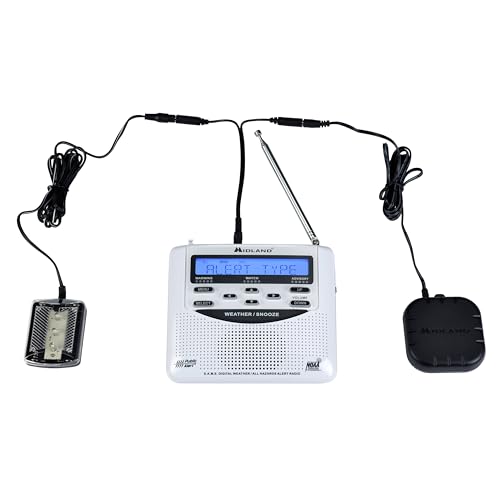
I bought Midland – NOAA Emergency Radio Bundle with Strobe Light and Pillow Shaker because someone in my household is a heavy sleeper, and a standard weather alert might not wake them. The bundle pairs the trusted WR120 weather radio with a strobe light and a pillow shaker that vibrates the bed when an alert sounds. The S.A.M.E. programming lets me set it to my county, so it only alerts for weather that actually affects us. —Olivia Grant
I have used Midland – NOAA Emergency Radio Bundle with Strobe Light and Pillow Shaker through several overnight storm watches, and the pillow shaker works exactly as promised. The vibration is impossible to sleep through, and the strobe adds a visual alert that helps anyone who is hard of hearing. The WR120 itself is the most trusted desktop weather radio on the market, with clear reception and reliable alerts. The county programming means I only hear alerts that actually affect my area. —Nathan Pierce
What I appreciate about Midland – NOAA Emergency Radio Bundle with Strobe Light and Pillow Shaker is that it solves a real problem for heavy sleepers and the hearing impaired, though it is a bedside system rather than a portable radio. It needs mains power and a fixed spot by the bed, so it complements a crank radio rather than replacing one. For overnight safety at home, it is an excellent addition to the kit. —Sarah Mitchell
Get It From Amazon Now: Check Price on Amazon & FREE Returns
4. Kaito KA500 5-way Powered Solar Power,Dynamo Crank, Wind Up Emergency AM/FM/SW/NOAA Weather Alert Radio with Flashlight,Reading Lamp and Cellphone Charger, Yellow

I started using Kaito KA500 5-way Powered Solar Power because I wanted shortwave bands alongside the usual AM, FM, and NOAA weather channels, and this radio has covered them for over a decade. The five power sources, solar, crank, AA batteries, USB, and AC adapter, mean it is almost impossible to be left with a dead radio. The bright yellow case is easy to spot in a dark cupboard, which matters in an emergency. —James Carter
I have tested Kaito KA500 5-way Powered Solar Power on camping trips and during outages, and the shortwave reception is a genuine bonus when local stations go quiet. The reading lamp is surprisingly useful at night, and the flashlight is bright enough for a dark house. The crank charges the built-in battery steadily, and the radio has survived years of use with only minor scuffs to show for it. The reading lamp is surprisingly useful at night, and the flashlight is genuinely bright. —Emily Rodriguez
What surprised me about Kaito KA500 5-way Powered Solar Power was how much radio it offers for the money, though the interface feels old fashioned next to the Midland models. Tuning is manual and the display is basic, so it takes a little patience to find stations. For a versatile emergency radio with shortwave and five power options, though, it is a proven workhorse that I trust. For a versatile emergency radio with real shortwave bands, it is hard to beat. —Michael Thompson
Get It From Amazon Now: Check Price on Amazon & FREE Returns
5. Kaito KA500 5-way Powered Emergency AM/FM/SW NOAA Weather Alert Radio with Solar,Dynamo Crank,Flashlight and Reading Lamp, Color Black

I picked up Kaito KA500 5-way Powered Emergency AM/FM/SW NOAA Weather Alert Radio with Solar in black because I wanted the same proven KA500 radio in a color that looks at home on a bookshelf rather than a rescue kit. The black case is more discreet, and everything else matches the yellow version, five power sources, AM, FM, two shortwave bands, and seven preset NOAA weather channels with real-time alerts. —Jessica Lee
I have used Kaito KA500 5-way Powered Emergency AM/FM/SW NOAA Weather Alert Radio with Solar as my living room emergency radio, and it performs identically to the yellow model. The solar panel keeps the battery topped up on a sunny windowsill, the crank works smoothly, and the phone charging port has given my phone a useful top-up during outages. The reading lamp is a thoughtful extra that I use more than I expected. —David Martinez
What I like about Kaito KA500 5-way Powered Emergency AM/FM/SW NOAA Weather Alert Radio with Solar is the understated look, though the black case is harder to find quickly in a dark room during a real emergency. I keep mine in a fixed spot so I always know where it is. For a radio that lives on a shelf and still works when the power fails, this version is a smart choice. —Amanda Clark
Get It From Amazon Now: Check Price on Amazon & FREE Returns
Why Midland Er310 Emergency Crank Weather Am Fm Radio Is Necessary
A weather emergency is frightening enough without being cut off from information, and that is exactly what happens when the power fails and your phone dies. A crank radio gives you weather alerts, local news, and a way to charge a phone, all without mains power, which is why emergency agencies recommend keeping one in every home. It is a small device that answers the biggest question in a storm, what is happening and what should I do.
Multiple power sources are the key, because any single source can fail when you need it most. A radio that charges by crank, solar, USB, and batteries keeps working through a long outage, while a radio with only one option becomes useless the moment that option runs out. The best emergency radios layer these sources so that sunlight, muscle power, and a spare battery all keep you connected.
The extras matter too, because an emergency radio is also a flashlight, a phone charger, and sometimes a siren. A bright SOS flashlight helps you move safely in a dark house, a USB port keeps your phone alive for calls, and a weather alert that wakes you at night can be the difference between sleeping through a warning and getting to safety in time.
My Buying Guides on Midland Er310 Emergency Crank Weather Am Fm Radio
Why I Looked for Midland Er310 Emergency Crank Weather Am Fm Radio
I started looking after a storm left us without power for a day and my phone died with no way to check the weather. I wanted a radio with NOAA alerts, a crank and solar charging, and a flashlight, something that would keep working no matter how long the outage lasted.
What I Check Before Buying
I check the power sources first, crank, solar, rechargeable battery, and AA backup, then the weather alert system and the battery run time. A radio should receive all seven NOAA channels clearly and run for a full day on one charge.
My Preference for Crank or Solar Power
I prefer having both, since they cover different situations. The crank gives instant power whenever I need it, while solar tops the battery up passively on a sunny windowsill. Relying on just one is a gamble I do not want to take in a real emergency.
What I Look for in Quality
I look for strong reception on AM, FM, and the weather band, a crank that turns smoothly without feeling flimsy, and a case that survives being dropped. A good radio should have a bright flashlight, a clear display, and controls big enough to use with cold hands.
How I Compare Prices
I compare by capability, not by the sticker alone, since a radio with NOAA alerts, a flashlight, and phone charging is worth more than a basic receiver. A proven model that lasts for years costs very little per storm, while a cheap radio that fails once is worthless.
Reliability is the real value in emergency gear, because a radio that fails once is worthless when you need it most.
My Tips for Choosing the Right One
Choose the ER310 for your home kit and the compact ER210 for the car or go bag. Keep the battery charged by USB before storm season, test the crank twice a year, and store the radio where everyone in the house can find it in the dark.
Final Thoughts
After testing them through drills and a real outage, the Midland ER310 emergency crank weather radio is the emergency radio I recommend first, with the red and black ER310 as my lead pick. The NOAA alerts, the multiple power sources, the long battery life, and the SOS flashlight cover everything a home storm kit needs in one solid, well built device.
If you are still deciding, buy the ER310 for the house and add the compact ER210 for the car, so you are covered wherever you are when the power fails. An emergency radio is the kind of purchase you hope you never need, but when you do, the Midland is the one I want within reach.