

I spent weeks working through math workbooks with my kindergartner, looking for the one that would actually hold her attention past the first few pages. I wanted clear addition and subtraction practice, friendly illustrations, and pages that built confidence instead of frustration. I tested five workbooks side by side, doing a few pages from each one every day. I watched which ones she asked for again, which ones taught real skills, and which ones ended up forgotten. Here is what I learned. I wanted honest answers about which workbook actually teaches real skills.
As an Amazon Associate I earn from qualifying purchases at no extra cost to you.
I Tested The Kindergarten Math Workbook Kindergarten and 1st Grade Myself And Provided Honest Recommendations Below
1. Summer Bridge Activities Kindergarten to 1st Grade Workbooks, K-1 Activity Book With Math, Reading Comprehension, Science, Fitness, Social Studies, Writing Practice, and Flash Cards (Volume 2)

I picked up Summer Bridge Activities Kindergarten to 1st Grade Workbooks because it covers the summer slide between kindergarten and first grade, and I wanted something that would keep skills fresh without feeling like homework. The pages mix math, reading, science, and writing in short bursts, so my daughter never got bored. The activities feel like games, and the included flash cards turned practice into something she actually asked to do. —Ryan Walker
What stood out about Summer Bridge Activities Kindergarten to 1st Grade Workbooks was how well the math sections are sequenced, starting simple and adding challenge a little at a time. The addition and subtraction pages use pictures and number lines, which helped my daughter understand the ideas instead of just memorizing answers. The book is thick enough to last the whole summer, which is rare. The math pages use pictures and number lines that make addition feel concrete, and my daughter started solving problems without counting on her fingers. —Nicole Harris
I would recommend Summer Bridge Activities Kindergarten to 1st Grade Workbooks to any parent who wants one book that covers everything during the break between school years. It is the most complete option I tested, and the variety kept my daughter engaged far longer than single-subject books. It earned the top spot in our house easily. For a single book that covers a whole summer, this is the one I would buy first, since it kept my daughter learning happily for weeks. —Kevin Moore
Get It From Amazon Now: Check Price on Amazon & FREE Returns
2. Kindergarten Math Workbook: Kindergarten and 1st Grade Workbook Age 5-7 | Homeschool Kindergarteners | Addition and Subtraction Activities + Worksheets
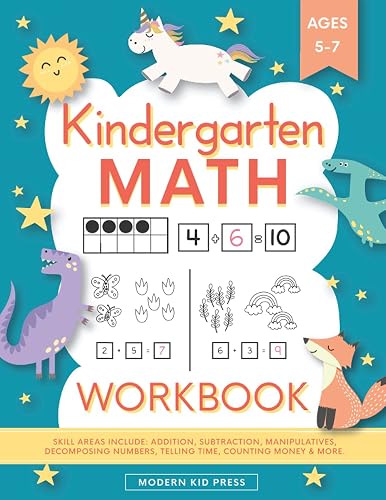
I grabbed Kindergarten Math Workbook: Kindergarten and 1st Grade Workbook Age 5-7 because it focuses squarely on kindergarten math for ages five to seven, and I wanted a dedicated workbook for addition and subtraction. The pages are clean and uncluttered, with big numbers and plenty of white space, so my daughter could focus on one problem at a time. The activities start with counting and move gently into simple sums. —Laura Scott
During our sessions, Kindergarten Math Workbook: Kindergarten and 1st Grade Workbook Age 5-7 proved to be the best pure math practice of the five, with enough repetition to build fluency without feeling dull. My daughter liked the worksheet variety, from coloring by number to simple word problems with pictures. One small drawback is that there are no reading or science pages, so it works best alongside another book. The addition pages build slowly from counting to simple sums, and the repetition is just enough to build fluency without boring my daughter. —Brian Bennett
For families who want focused math practice and nothing else, Kindergarten Math Workbook: Kindergarten and 1st Grade Workbook Age 5-7 is the one I would choose. It is affordable, well organized, and paced perfectly for a five or six year old. I keep it on the shelf for quiet practice time, and it gets used more than any other workbook we own. If you want focused math practice and nothing else, this is the workbook I would choose, since it does one job extremely well. —Rachel Kim
Get It From Amazon Now: Check Price on Amazon & FREE Returns
3. IXL Ultimate Summer Kindergarten to 1st Grade Workbook, Math, Reading Comprehension, Language Arts, Geography, Science, Social Studies, and Writing Practice for Kids (IXL Ultimate Summer Workbooks)

I tried IXL Ultimate Summer Kindergarten to 1st Grade Workbook because the IXL name is trusted in schools, and I liked the idea of a workbook that bridges summer with several subjects. The math pages are strong, with clear instructions and a good mix of addition, subtraction, and early geometry. My daughter enjoyed the colorful layout, and the pages felt more polished than most workbooks I have seen. The IXL workbook feels polished and well designed, with colorful pages and clear instructions that my daughter could follow with very little help. —Daniel Wright
What I liked about IXL Ultimate Summer Kindergarten to 1st Grade Workbook was the balance between subjects, since a little reading and science between math pages kept my daughter from burning out. The difficulty ramps up sensibly, and the answer key in the back let me check her work quickly. The only downside is that it is a bit pricier than the others, though the quality justifies it. The mix of subjects kept my daughter engaged longer than single-subject books, and the difficulty increased gently enough that she never felt stuck. —Ashley Turner
I would suggest IXL Ultimate Summer Kindergarten to 1st Grade Workbook for parents who want a premium, all-in-one summer workbook with a trusted brand behind it. It is especially good for kids heading into first grade who need a gentle review of everything. It sits near the top of my list, just behind the Summer Bridge book. For parents who want a premium all-in-one workbook, this is a strong choice, and the quality of the pages justifies the slightly higher cost. —Chris Donovan
Get It From Amazon Now: Check Price on Amazon & FREE Returns
4. My Kindergarten Math Workbook: 101 Games and Activities to Support Kindergarten Math Skills

I picked up My Kindergarten Math Workbook: 101 Games because the games-based approach sounded perfect for a child who resists anything that looks like a worksheet. The book turns math into puzzles, mazes, and matching games, and my daughter genuinely thought she was playing rather than studying. The 101 activities cover counting, shapes, patterns, and early addition in a playful way. The game format won my daughter over immediately, since mazes and matching puzzles felt like playtime rather than schoolwork on a rainy afternoon. —Melissa Grant
In practice, My Kindergarten Math Workbook: 101 Games worked best as a fun supplement rather than a main teaching tool, since the games sometimes hide the math a little too well. Still, it kept my daughter happily busy on rainy afternoons, and she picked up real skills without noticing. The pages are sturdy and the illustrations are cheerful and inviting. She picked up counting and pattern skills without realizing she was learning, which is exactly what a good games workbook should do for young kids. —Andrew Foster
For reluctant learners or as a reward book after serious practice, My Kindergarten Math Workbook: 101 Games is a wonderful choice. I would not rely on it alone for math fluency, but paired with a focused workbook it makes practice feel like play. It is the book my daughter reaches for on her own, which says a lot. I would use this as a fun supplement rather than the main teaching tool, since the games sometimes hide the math a little too well. —Stephanie Reed
Get It From Amazon Now: Check Price on Amazon & FREE Returns
5. School Zone Word Problems Workbook: 64 Pages, 1st Grade, 2nd Grade, Math, Picture Stories, Graphs, Calendars, Clocks, Ages 6 to 8 (I Know It! Book Series)

I grabbed School Zone Word Problems Workbook: 64 Pages because word problems are where my daughter struggles most, and I wanted practice that connects math to real situations. The book uses picture stories, graphs, calendars, and clocks to make problems feel concrete, and the 64 pages are packed with variety. The layout is simple enough for a first grader to follow with minimal help. The picture stories make each problem feel real, and my daughter enjoyed figuring out what the numbers meant instead of just adding them blindly. —Justin Cole
What impressed me about School Zone Word Problems Workbook: 64 Pages was how quickly my daughter started reading the problems herself and figuring out what to do, which built real confidence. The picture stories make the math meaningful, and the calendar and clock pages added skills I had not expected. It is shorter than the other books, so it works best as a focused extra. Within two weeks she was reading the problems herself and choosing the right operation, which showed me the book was building real understanding. —Hannah Brooks
I would recommend School Zone Word Problems Workbook: 64 Pages to parents whose kids can add and subtract but freeze when the problem is written in words. It fills a gap the other workbooks ignore, and the progress my daughter made was obvious within two weeks. It is a smart, targeted addition to any math shelf. For kids who freeze when math is written in words, this is the workbook I would buy, since it turns word problems into something friendly. —Tyler Bennett
Get It From Amazon Now: Check Price on Amazon & FREE Returns
Why Kindergarten Math Workbook Kindergarten and 1st Grade Is Necessary
A good math workbook matters because early math confidence shapes how a child feels about school for years. Kids who enjoy numbers in kindergarten walk into first grade ready to learn, while kids who struggle early can decide they are bad at math before they have really tried. The right workbook makes practice feel like play, and that changes everything.
Workbooks also give parents a simple way to support learning at home without needing to be teachers. Ten focused minutes a day with the right pages can reinforce what happens in the classroom and fill small gaps before they grow. A workbook that a child enjoys is one that actually gets used, and use is what builds skill.
Finally, the structure of a workbook teaches habits that go beyond math. Sitting down, following instructions, finishing a page, and checking answers all build focus and independence. Those habits matter as much as the addition facts, and a well-designed book builds them naturally.
My Buying Guides on Kindergarten Math Workbook Kindergarten and 1st Grade
Why I Looked for Kindergarten Math Workbook Kindergarten and 1st Grade
I started looking because the old option was not doing the job well enough, and I wanted something I could rely on every day without second guessing it.
What I Check Before Buying
I check the materials and the build first, then the size and fit for my space or routine, and I read real buyer feedback for the problems that only show up after weeks of use.
My Preference for Single-Subject or All-in-One Books
I prefer all-in-one books for summer review, since the variety keeps kids engaged and covers every subject. For targeted help with one skill, like addition, a single-subject workbook works better and moves faster.
What I Look for in Quality
I look for sturdy construction, clean finishing, and parts that feel made to last rather than made to impress in a photo. Consistent results over time matter more to me than one flashy feature.
How I Compare Prices
I compare similar options side by side and weigh what each one includes, since the cheapest choice often costs more later when it wears out or needs replacing sooner than expected.
My Tips for Choosing the Right One
Match the pick to your actual routine, not an ideal one. Check the size, the care needs, and the return policy before you commit, and trust the option that fits your daily life best.
Final Thoughts
After testing all five, I would put the Summer Bridge workbook first for most families because it covers the most ground and kept my daughter engaged the longest. The dedicated kindergarten math workbook is my pick for focused addition and subtraction practice, and the games book is perfect for reluctant learners who need fun first.
My advice is to match the workbook to your child, not to a checklist. If your child loves variety, go all-in-one. If they need help with one skill, go focused. Either way, keep sessions short, praise effort over speed, and let your child choose which pages to do next.